Units and Measurements
About Course
Units and Measurements
Physics is not just about numbers—it’s about measuring reality accurately. Every physical quantity we study—length, time, mass, force, energy—needs a standard way of measurement. This is where Units and Measurements become the foundation of all Physics.
This topic helps you understand how we define, measure, and express physical quantities with precision and reliability.
What this topic is really about (Intuition)
Whenever you say something like:
- “The distance is 10” → incomplete ❌
- “The distance is 10 meters” → meaningful ✅
👉 A number without a unit has no physical meaning.
Core Concepts Covered
1. Physical Quantities
- Anything that can be measured
- Examples: length, mass, time, velocity, force
2. Units and Systems of Units
- A unit is a standard reference for measurement
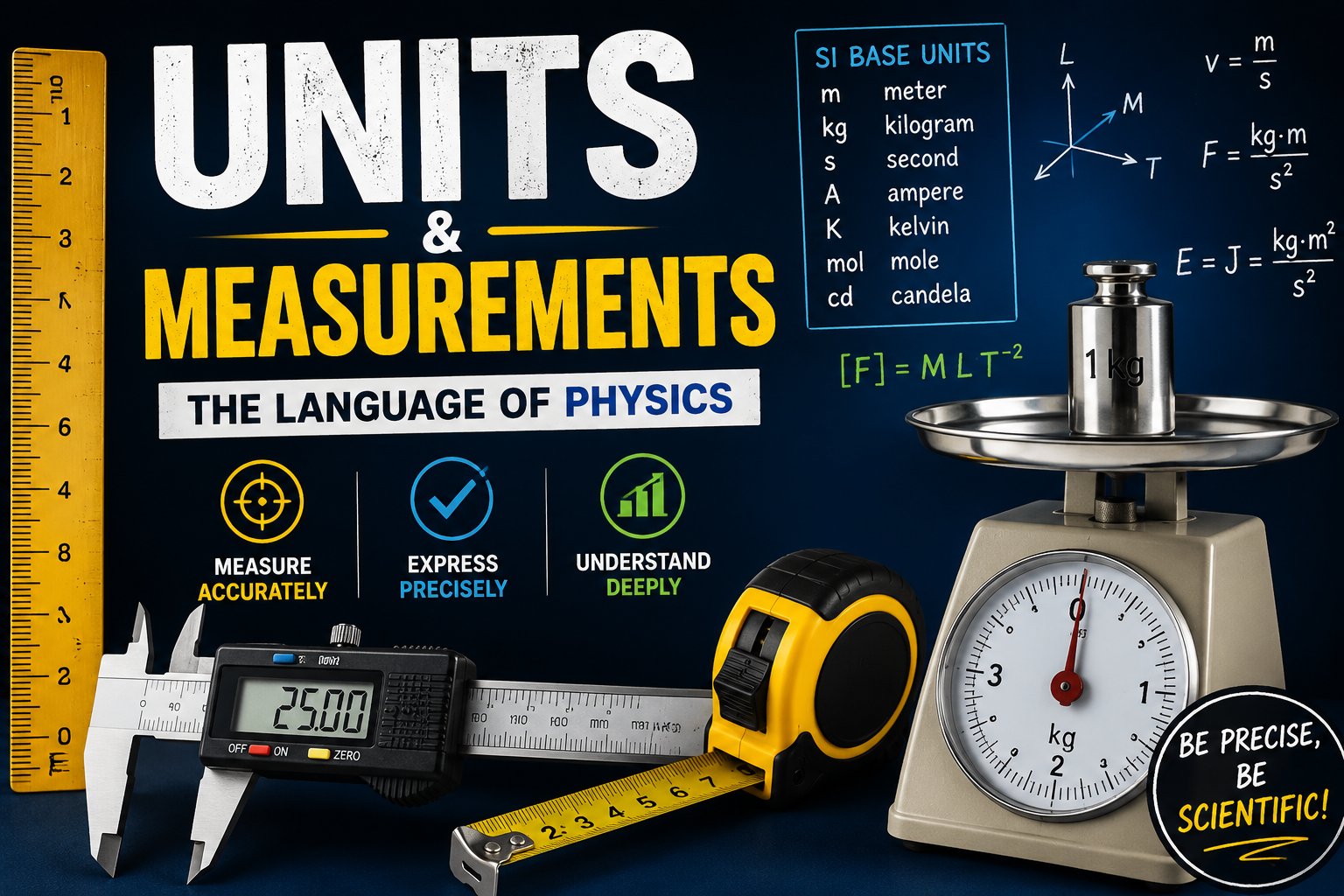
- SI system (International System of Units) is the most widely used
Fundamental Units (SI):
- Length → meter (m)
- Mass → kilogram (kg)
- Time → second (s)
- Electric current → ampere (A)
- Temperature → kelvin (K)
- Amount of substance → mole (mol)
- Luminous intensity → candela (cd)
3. Derived Units
- Formed by combining fundamental units
- Example:
- Velocity → m/s
- Force → kg·m/s²
4. Dimensional Analysis
- Expressing physical quantities in terms of fundamental units
- Helps to:
- Check correctness of equations
- Derive relationships
- Convert units
👉 Example:
Force → [MLT−2][M L T^{-2}]
5. Accuracy, Precision & Errors
- Accuracy → closeness to true value
- Precision → consistency of measurements
Types of Errors:
- Systematic errors
- Random errors
👉 Understanding errors helps in trusting your results
6. Significant Figures
- Reflect the precision of measurement
- Rules for:
- Counting significant figures
- Rounding off
7. Measurement Techniques
- Proper use of instruments
- Least count concept
- Minimizing errors
Why This Topic is Important
- Forms the base of all Physics problems
- Helps avoid silly mistakes in exams
- Essential for numerical accuracy in JEE/NEET
- Builds scientific thinking: “How reliable is my answer?”
Core Insight
👉 Physics is not just about solving—it’s about measuring correctly and expressing meaningfully.
Course Content
Intro
-
Why Units?
05:18
Student Ratings & Reviews

No Review Yet