
An inclined plane is bent in such a way that the vertical cross-section is given by 𝑦 = 𝑥²/4, where y is in vertical and x in horizontal direction. If the upper surface of this curved plane is rough with coefficient of friction μ = 0.5, determine the greatest vertical height (in cm) at which the block can remain at rest without sliding down the surface.
- 2021
- JEE
- Laws of Motion
- Friction
- 11th
Step-wise Solution
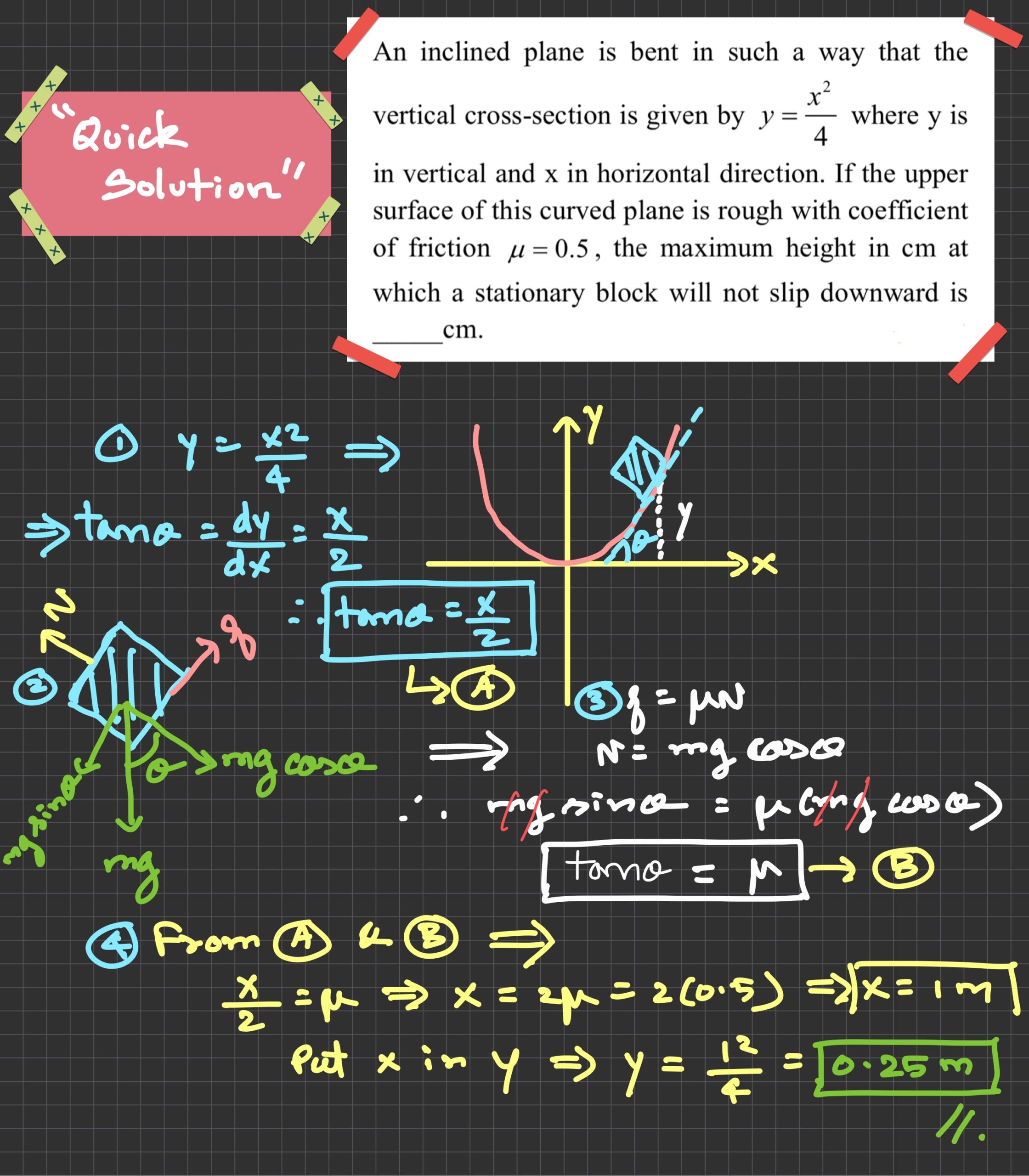
Problem Logic decode
In this problem, the shape of the surface is not mentioned directly; rather, it is given in terms of an equation. By using the plotting method, such as substituting multiple integers in the x variable, finding the y variable, and plotting it in a graph, you get the shape of the surface. Also, by looking at the equation, it can be said it is an equation of a parabola open upward along the +Y axis on either side, passing in the 2nd quadrant and 1st quadrant through the origin.
Now, if the block is placed on the surface, the block is held due to the friction present on the surface (given coefficient of friction = 0.5). To find the height at which the block will never slip or slide, let’s use the logic that all forces must be balanced at that point where the block is placed on the surface. That is, the forces that come into action are the gravitational force (due to Earth), the normal reaction (due to contact), and the frictional force (due to a rough surface). All three will balance each other, making the net force on the block zero.
We know the slope of the parabola varies continuously. Therefore, having the equation relating X and Y, differentiating Y with respect to X gives the slope value. Now, by drawing the free body diagram, find the value of X using the slope value. Since we have the relation between X and Y, knowing the value of X, Y can be calculated.