
A vernier calliper has its main scale of 10 cm equally divided into 200 equal parts. Its vernier scale of 25 divisions coincides with 12 mm on the main scale. The least count of the instrument is
- Doubt
- NEET
- Experimental skills
- Vernier Calliper
- 11th
Step-wise Solution :
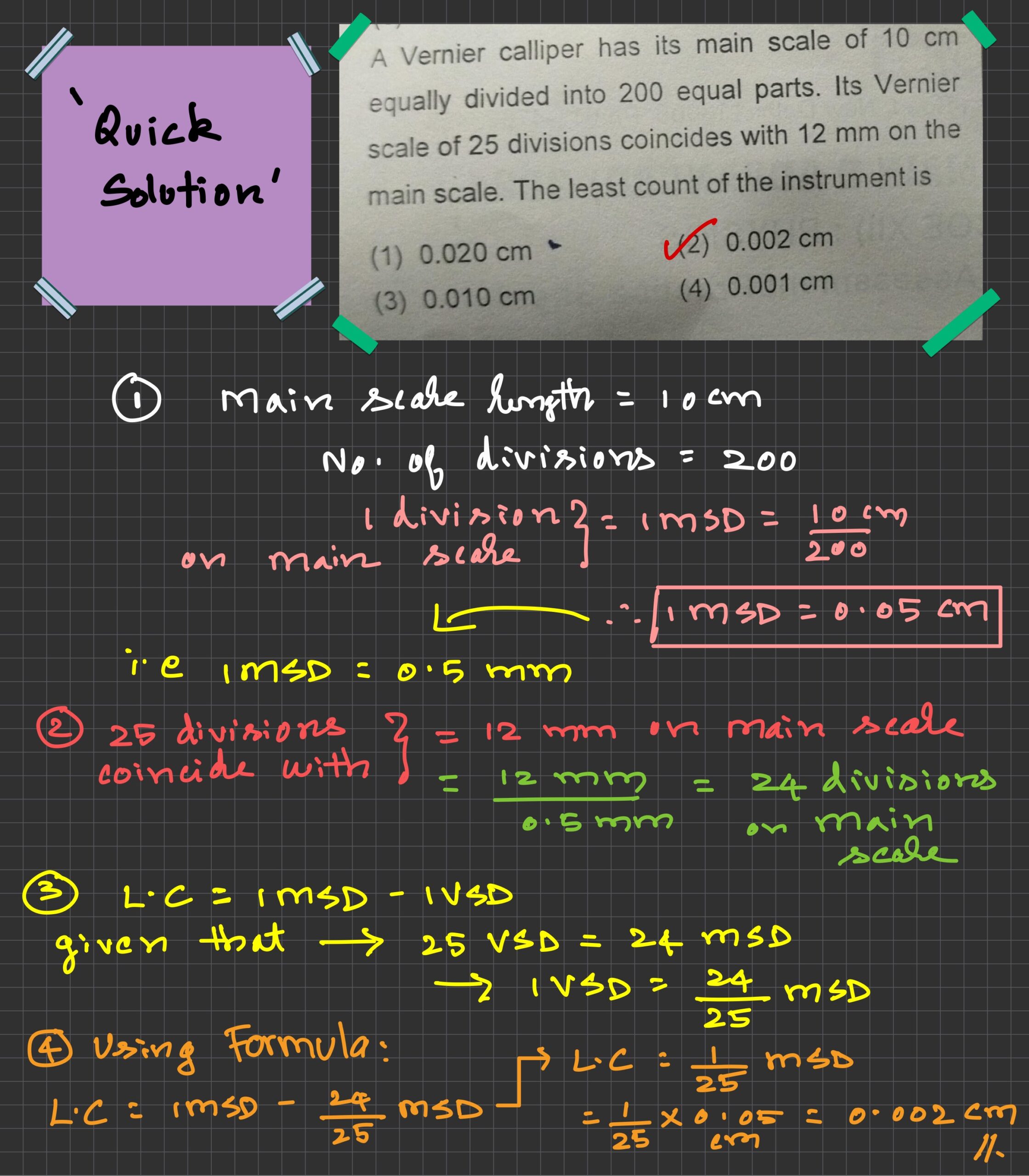
Problem Logic decode
The least count of a vernier caliper refers to the smallest measurement that it can accurately read. It represents the resolution or precision of the instrument. Understanding how to determine the least count involves comparing the scales of the main scale and the vernier scale.
1. Basic Components of Vernier Caliper
A vernier caliper consists of
A main scale marked in millimeters (or cm).
A vernier scale that slides along the main scale, divided in such a way that a certain number of divisions on it coincide with a different number of divisions on the main scale.
2. Understanding Least Count: The Logical Approach
To find the least count, we use the concept of difference in length between one main scale division and one vernier scale division.
Let’s say
1 MSD (Main Scale Division) = 1 mm
n VSD (Vernier Scale Divisions) = (n – 1) mm
The least count is the difference between the value of 1 MSD and 1 VSD:
For example, if 10 vernier divisions = 9 main scale divisions, then
1 MSD = 1 mm
10 VSD = 9 mm ⇒ 1 VSD = 0.9 mm
LC = 1 – 0.9 = 0.1 mm
Hence, the least count of this vernier caliper is 0.1 mm.
3. Why the Logic Works
The least count works on the principle of aligning one vernier division with a main scale division — when that happens, we know how much smaller each vernier division is compared to a main scale division. This small difference becomes the unit of fine measurement — the least count.