
A stone falls freely under gravity. It covers distances d1, d2, and d3 in the first 2 seconds, the next 2 seconds, and the further next 2 seconds, respectively. Find the relation between d1, d2, and d3.
- Doubt 1
- NEET
- Motion in a Straight line
- Free fall
- 11th
Step-wise Solution :
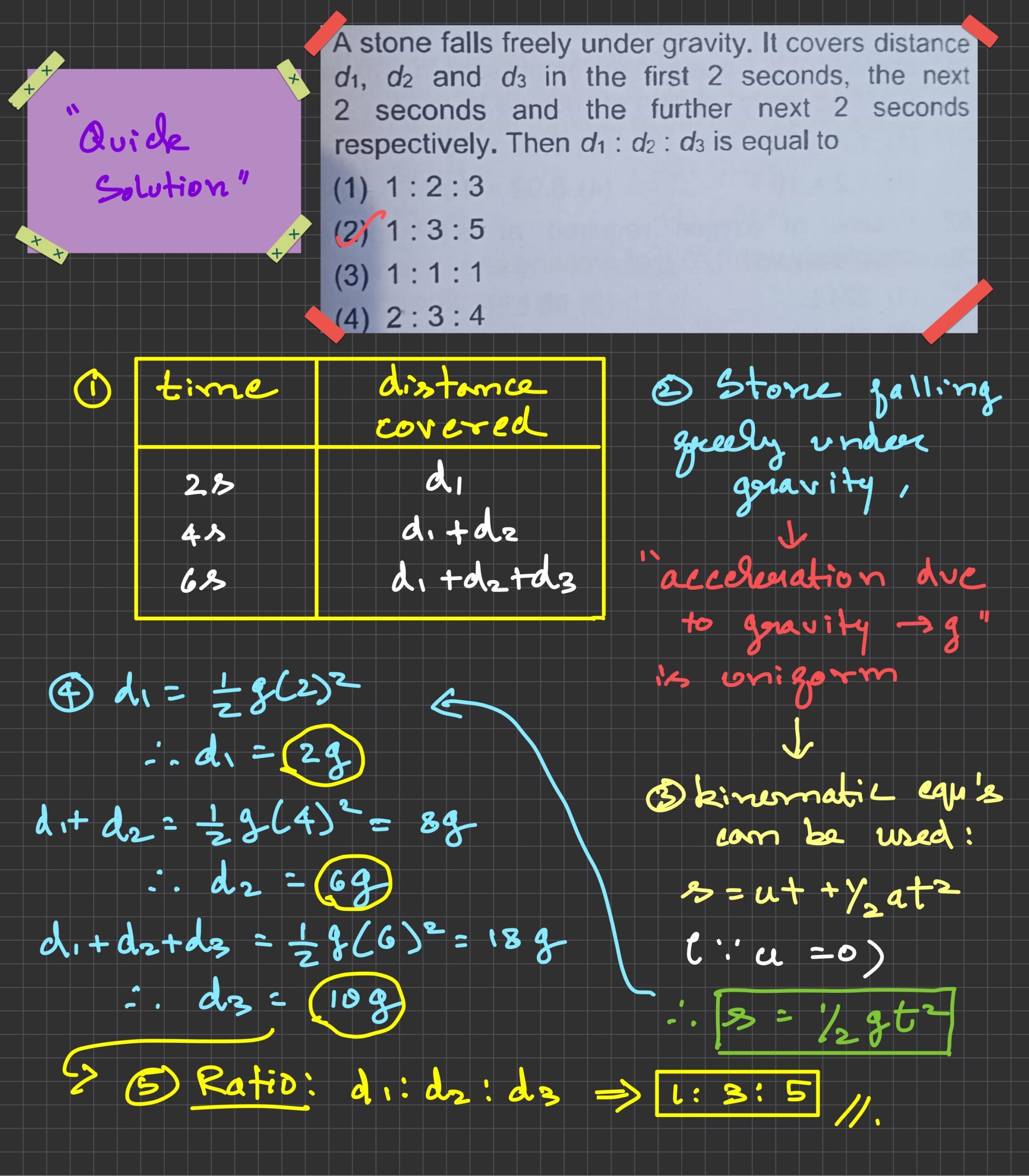
Problem Logic decode
As a stone falls in a downward direction, it covers unequal distances in equal intervals of time, which is a nonuniform motion or uniformly accelerated motion of the body. Here the acceleration is acceleration due to gravity (g), which is uniform or constant in this case (assuming objects are near to the earth’s surface). Since the stone falls, the initial velocity must be zero, and the velocity of the body increases as it moves in a downward direction.
When does the body speed up and slow down? If the direction of velocity and the direction of acceleration are acting in the same direction, the body speeds up, and if they are in opposite directions, the body slows down.
So, to solve this question, we can make use of the kinematic equations (equations of motion) as the condition, such as “acceleration must be uniform,” is met. There are 3 equations, right? How to pick the required equation? In the problem, since time is involved, let’s omit the 3rd equation, because the 3rd one is independent of time. Whereas the first 2 equations are time-dependent. In 2 equations, the 1st one is used for solving final speed or velocity, and the 2nd is used for calculating distance or displacement.
Since, in this problem, distance is involved, we need to go for the 2nd equation and substitute initial velocity as zero (as it is given in the question, “the stone falls”). In the place of acceleration, substitute ‘g,’ as we know that the earth is the body that is accelerating the stone towards its center. For calculating d1, the time taken is 2 seconds from the start, and for the distance d1+d2, the time taken is (2 + 2) seconds, and for the distance d1+d2+d3, the time taken is (2+2+2) seconds. From these values, we can get the d1, d2, and d3, respectively.
From the values, it must be observed that the values are in an odd number ratio. This is first performed by “Galileo,” which is famously known as “Galileo’s odd number ratio.”