
A particle is moving towards the east with a velocity of 20 m/s. In 20 s, it changes its velocity to 60° north of east. Find its average acceleration.
- Doubt
- NEET
- Motion in a Plane
- Kinematics
- 11th
Step-wise Solution :
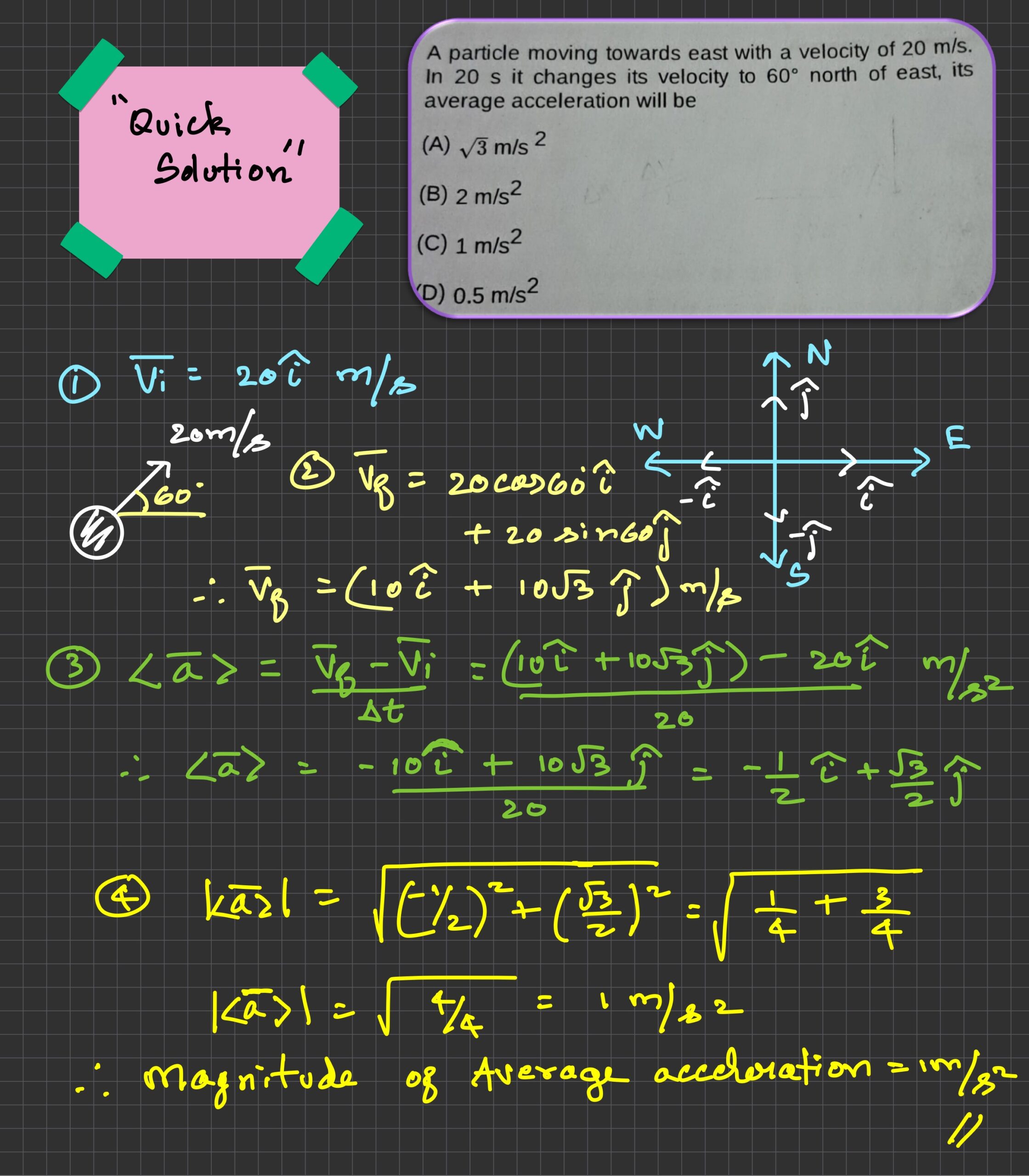
Problem Logic decode
A particle is initially moving in an east direction with a magnitude of 20 m/s velocity. If the particle changes its direction alone, even without a change in magnitude, velocity also changes. We know if velocity changes, there is an acceleration acting along the direction in which the velocity changes. In the given problem, since it is changing its direction from east to 60 degrees north of east (i.e., turned or tilted along 60 from east towards north direction).
With the angle value available, final velocity can be broken down in terms of components along east and north directions. So, using vectors easily, we can use the formula: average acceleration is equal to the change of velocity from final to initial by the time taken for that change in velocity. Plug in all the values into the equation and calculate average acceleration. But the final answer is obtained in terms of components such as the x-component and the y-component. How to find a single answer? Using ‘ Pythagorus theorem’, the magnitude of average acceleration is easily calculated.