
A juggler is juggling 7 balls simultaneously. If the time gap to pass the ball from one hand to the other is 2 seconds, then find the maximum height attained by each ball.
- Doubt
- NEET
- Motion in a Straight line
- Kinematic equations
- 11th
Step-wise Solution :
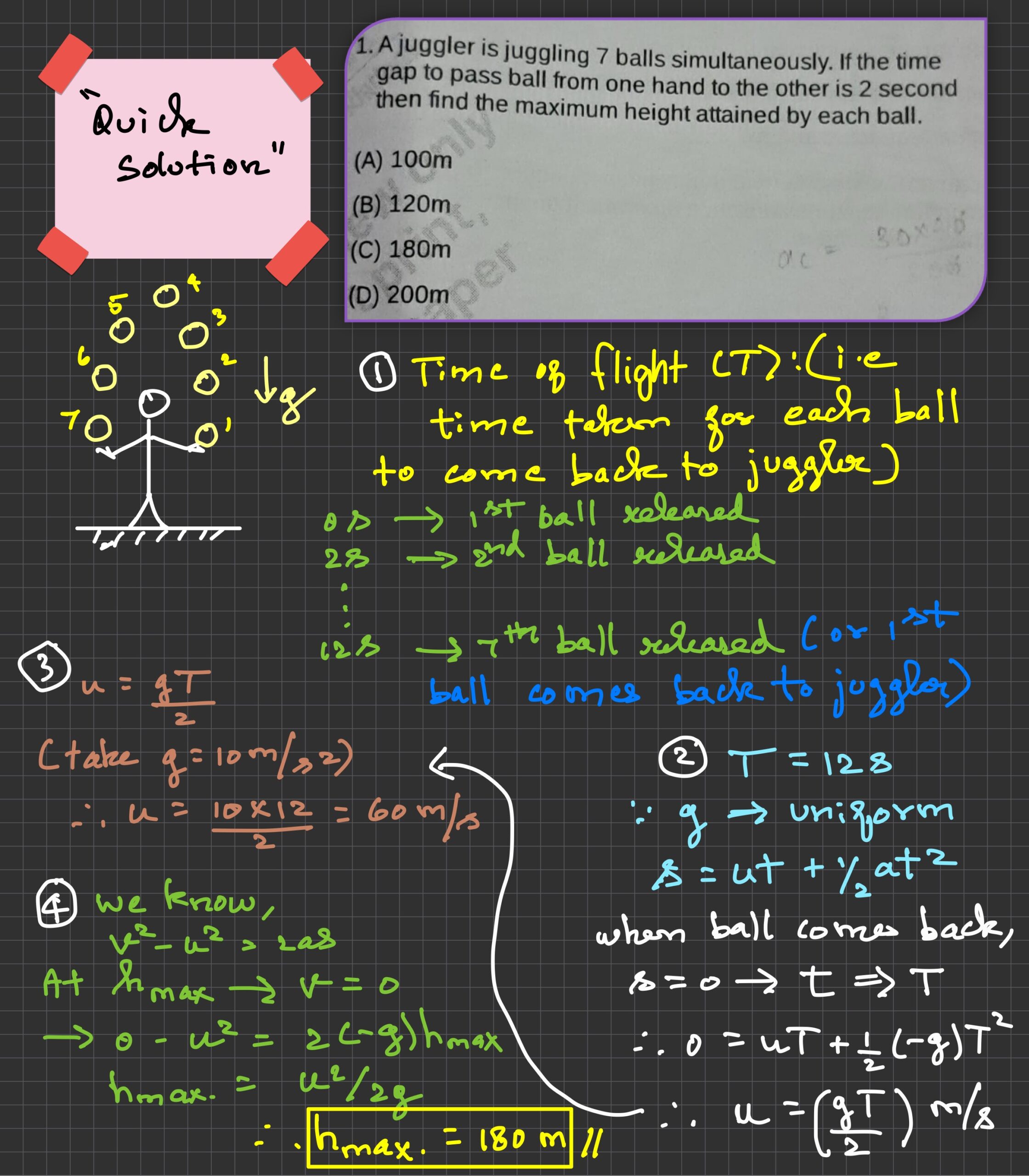
Problem Logic decode
A juggler is a person who juggles (throws in a pattern for an entertaining purpose) balls. In this problem, the juggler juggles 7 balls simultaneously. So, he juggles at a rate of one ball per 2 seconds. Logically, at 0 seconds, the 1st ball will be released; after 2 seconds, the 2nd ball will be released; in 4 seconds (i.e., after the next 2 seconds), the 3rd ball will be released, etc. When a juggler throws the 7th ball from his/her right hand, the 1st ball must come back to the left hand in order to juggle continuously at a constant rate of 1 ball per 2 seconds. Logically, when the 7th ball is released from the right hand or the 1st ball comes back to the left hand, it will occur at 12 seconds. That is, one ball will take 12 seconds to come back to the juggler.
Therefore, if one ball spends 12 seconds in the air, then the initial velocity at which it has been thrown by the juggler can be found by using kinematic equations (equations of motion). In order to apply kinematic equations, the condition “acceleration must be uniform” must be met. In this problem, since the only acceleration is ‘acceleration due to gravity,’ the condition is satisfied; therefore, kinematic equations can be used. Now comes the question: which equation can be used? If the problem involves time, then either it must be the 1st or 2nd equation, whereas the 3rd equation is independent of time. Since the initial velocity is to be found, let’s use the 2nd equation. Logically, when the ball comes back to the juggler, then the total or net vertical displacement of the ball is zero. If displacement becomes zero, then the time taken will be logically equal to 12 seconds. From this, the initial velocity of the ball thrown by the juggler can be found.
Having an initial velocity value, how do you find the maximum height reached by the ball? Well, again, we can use kinematic equations! At maximum height, the ball stops for an instant, where velocity becomes zero. Therefore, in the upward motion of the ball from the juggler’s hand, having an initial velocity value and taking the final velocity as zero under acceleration due to gravity, using the 3rd equation of motion, the maximum height reached can be found.
Note: When using kinematic equations, don’t forget to use sign conventions!