
Given data
The masses of two particles are the same. The ratio of the radius of curvature of the two particles is 3:4. If the centripetal forces acting on both the particles are the same, we need to find the ratio of their linear velocities.
It is a graphical method to add two given vectors to find the resultant vector. There are three steps involved in solving the resultant vector.
Motion is a change in the position of an object with respect to time. Circular motion means a change in position of an object in a circular path with respect to time. The uniform circular motion means equal change in position of an object in a circular path in equal intervals of time.
The force that always acts towards the center when the body moves in a circular path is known as centripetal force. It arises due to the presence of centripetal acceleration. ‘Centri’ means ‘center,’ and ‘petal’ means ‘seeking’ (searching).
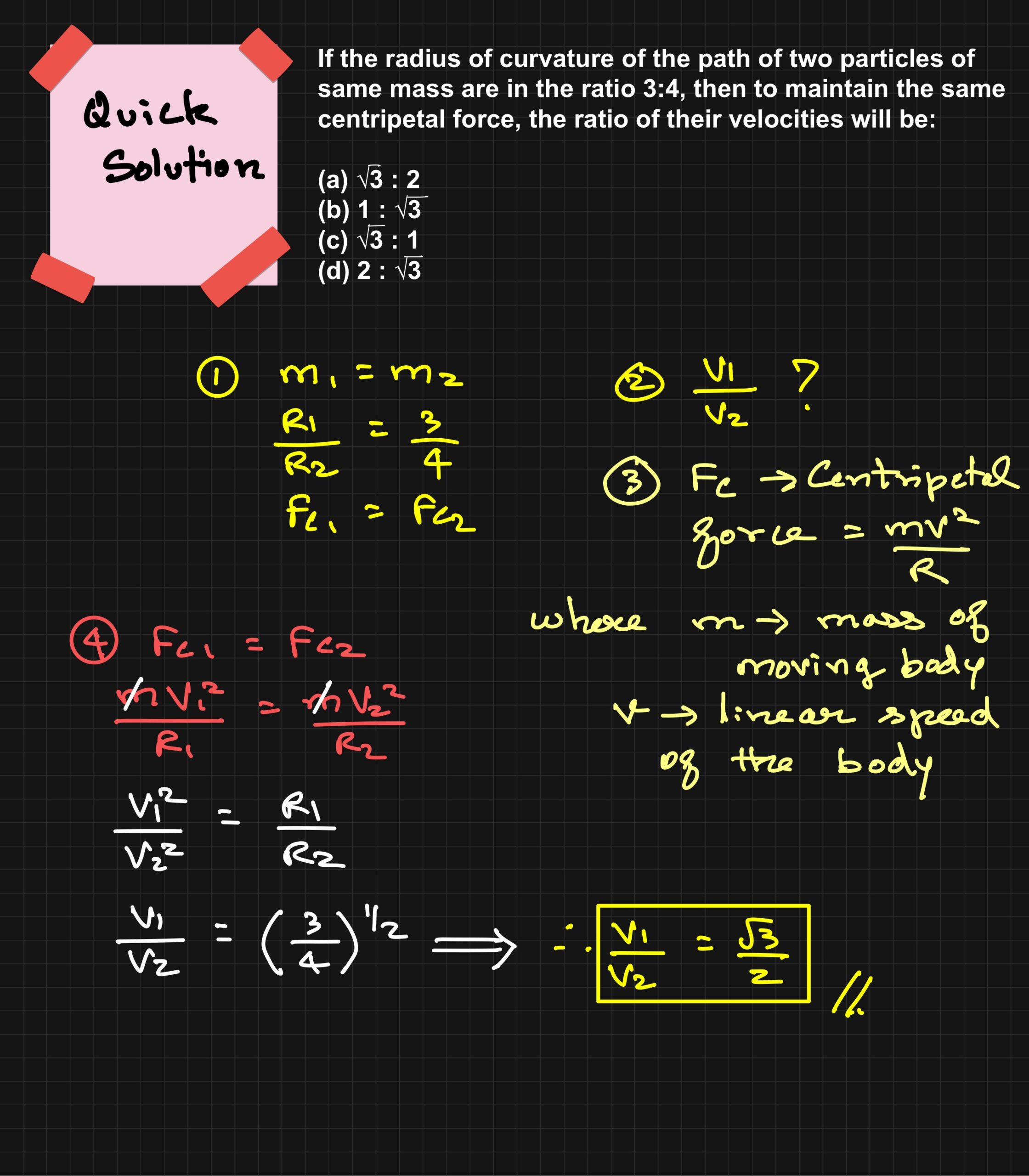
The masses of two particles are the same. The ratio of the radius of curvature of the two particles is 3:4. If the centripetal forces acting on both the particles are the same, we need to find the ratio of their linear velocities.
The derivation logic is included in the stepwise solution for your reference. The formula of the centripetal force is mass times the square of linear velocity divided by the radius of the circular path. As per the given data, the centripetal force of the first particle must be equal to the centripetal force of the second particle.
Since the masses of both of the particles are the same, they will cancel on both of the sides of the equation. Therefore, the ratio of the velocity of the first particle to the velocity of the second particle must be equal to the square root of the ratio of the linear velocity of the first to the second particle. Substituting the values, velocity ratio is obtained.