JEE Advanced Question #1

Step-wise Solution

Want your doubt solved like this?
Submit your Doubt
Question:
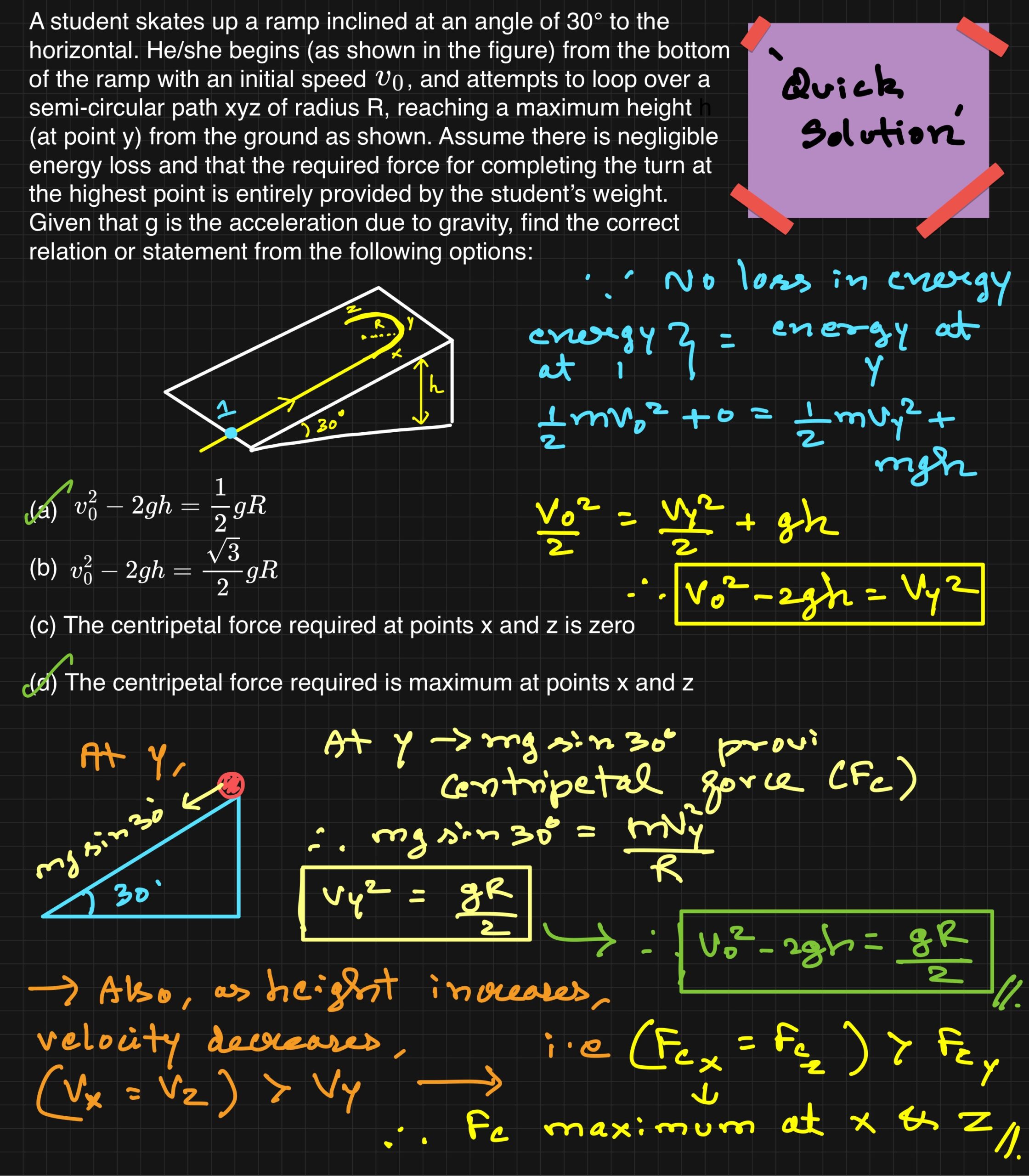
A student skates up a ramp that makes an angle 30° with the horizontal. He/she starts (as shown in the figure) at the bottom of the ramp with speed v₀ and wants to turn around over a semi-circular path xyz of radius R during which he/she reaches a maximum height h (at point y) from the ground as shown in the figure. Assume that the energy loss is negligible, and the force required for this turn at the highest point is provided by his/her weight only. Then (g is the acceleration due to gravity):

(a) v₀² − 2gh = ½ gR
(b) v₀² − 2gh = (√3 / 2) gR
(c) the centripetal force required at points x and z is zero
(d) the centripetal force required is maximum at points x and z

Concept Flashcards

student skates

MCQ challenge

Problem Logical Approach

Step 1

Absence of Non-conservative forces

Non-conservative forces such as friction and air drag are not mentioned in the problem. It is assumed that non-conservative forces are absent in the given problem. Hence, conservation of energy can be applied. That is, the total initial energy of the skater will be equal to the total final energy of the skater. 

Step 1
Step 2

Initial energy of the skater

As a skater has an initial velocity at the bottom of the ramp, the skater is said to have kinetic energy. Since the skater climbs up the ramp, the bottom of the ramp is chosen as a reference level. Since to evaluate potential energy we need a reference level. By convention, we know the reference level has zero potential energy. Therefore at bottom of ramp, the skater has only kinetic energy. 

Step 2
Step 3

Final energy of the skater

As the skater climbs the ramp, the height increases; that is, potential energy increases at the cost of kinetic energy (as we know, energy can neither be created nor destroyed). As mentioned in the problem, the point Y is the maximum point reached by the skater, where the height of the ramp at Y is ‘h.’ Therefore, two things need to be noticed. At maximum height, the skater does not come to a stop but rather takes a semi-circular turn along the points X, Y, and Z. Therefore, the skater is in motion at point Y; hence, kinetic energy will be there, and also the skater reaches point Y against the gravitational pull of earth, which is stored as potential energy. Thus, both kinetic and potential energy are present at Y. 

Step 3
Step 4

The unknown velocity of the skater at point Y

As the skater climbs the ramp, the velocity decreases because the acceleration due to gravity opposes the motion of the skater. Thus, at point X, the velocity will definitely be less than the velocity of the skater at the bottom of the ramp. Hence, logically, at point Y, the velocity will still be lower than at point X. So, to find the unknown velocity at point Y, centripetal force can be used because at X, the skater takes a turn with his/her own weight in a semi-circular path XYZ. But, to note, since the ramp is inclined, not the entire weight of the skater is used to turn, as some part of the weight is balanced by the ramp itself by the contact force, such as normal reaction. Hence, a component of the weight of the skater equating it to the centripetal force formula gives the value of the unknown velocity at Y.

Step 4
Step 5

The correct relation

With the help of the centripetal force, after finding the unknown velocity at point Y, substitute the value in the conservation of energy equation to get the final answer. Since the magnitude of centripetal force depends on the mass of the skater, the linear speed of the skater, and the radius of the circular path, as the skater climbs at point X, the centripetal force will be maximum at X and Z (since Z is at the same height) compared to point Y (as velocity decreases as the skater climbs high). Hence, options (a) and (d) are correct. 

Step 5

Leave a Comment

Your email address will not be published. Required fields are marked *

Other problems on similar topic

© uKarpy 2025 | All rights reserved.

Was this helpful?

Thanks for your feedback!

Thank you for your response!